Ireland during the Second World War by Bryce Evans
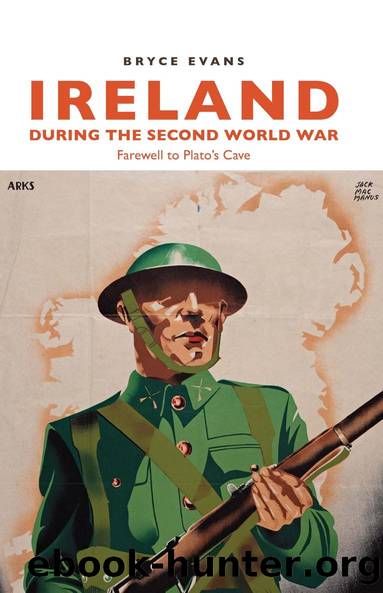
Author:Bryce Evans [Evans, Bryce]
Language: eng
Format: epub
Tags: Nonfiction, History, Ireland, British
ISBN: 9781526111302
Publisher: Manchester University Press
Published: 2016-05-16T04:00:00+00:00
6
Church and state
The key to Irelandis the Church, its pontiffs, the Nuncio, MacRory and McQuaid and I think we should bother less about relations, good or bad, with the Government and more with relations with the Catholic Church.
John Betjeman, 21 March 1943
Subsidiary function
The exercise of collective responsibility to overcome material shortages infused political, economic and social debate during the Emergency. It also came to affect many aspects of everyday life: Irish people were not used to queuing, yet during the Emergency, food queues became a âfact of lifeâ.1 These new âfacts of lifeâ were ordered by the state. At the same time, Catholic social thought proffered an alternative form of social and economic organisation. In this schema, by contrast, the stateâs role was reduced to a âsubsidiary functionâ.2 Catholic social doctrine was based on the papal encyclicals Rerum Novarum (1891) and Quadragesimo Anno (1931). The latter elaborated papal doctrine on twentieth-century social and economic questions, declaring that in its pursuit of the âcommon goodâ, the state should extend âspecial care and foresightâ to the âgreat mass of the needyâ.3 On the other hand, the state should not encroach on the just freedom of individuals and families. It reaffirmed the rights of private property and declared that the state was ânot permitted to discharge its duty arbitrarilyâ.4
Party political affiliations to Catholic social thought became confused in the turbulent political circumstances of the 1930s.5 De Valeraâs 1937 Constitution was pervasively Catholic in comparison to the Free State Constitution of1922. Nonetheless, a substantial number of clergy and theologians remained unreconciled to Fianna Fail, and around the middle of the decade, several senior ecclesiastics endorsed the United Ireland Party, an amalgamation of the Blueshirts, Cumann na nGaedheal and the Centre Party.6 During the Emergency, social Catholicism, or vocationalism, persisted as an influential form of public opinion, and conformity with the churchâs moral and social principles remained a priority for Irish Catholics.7
The government responded to the growing prominence of vocationalism by establishing the Commission on Vocational Organisation in January 1939. The commissionâs 1943 report warned of the danger, on the one hand, of âcompetitive anarchyâ and, on the other, of âstate regimentationâ.8 The latter consideration united a commission delayed in its appointment and hamstrung by its size and diversity of interests. To quote its chairman, Bishop Michael Browne of Galway, âthe one point on which all the members are agreed is that they abhor totalitarianism or state- domination in any form ⦠whether communist, socialist or fascistâ.9 During the Emergency, the state accumulated power and initiated schemes which, in encroaching upon individual freedom and property rights, tickled this particular nerve. This chapter details the complex interactions between church and state at this time in the spheres of the regulated marketplace, civil and canon law, and money and credit.
âA sin that cries to heaven for vengeanceâ: church, state and marketplace
Using the Irish Press, Radio Eireann, and its power of censorship over the rest of the media, the Fianna Fáil governments of the Emergency carefully cultivated an image of the Irish people as exceptional in shunning the base lure of materialism.
Download
This site does not store any files on its server. We only index and link to content provided by other sites. Please contact the content providers to delete copyright contents if any and email us, we'll remove relevant links or contents immediately.
The Vikings: Conquering England, France, and Ireland by Wernick Robert(84375)
Ali Pasha, Lion of Ioannina by Eugenia Russell & Eugenia Russell(40315)
The Conquerors (The Winning of America Series Book 3) by Eckert Allan W(37892)
The Vikings: Discoverers of a New World by Wernick Robert(37006)
Cecilia; Or, Memoirs of an Heiress — Volume 1 by Fanny Burney(32635)
Cecilia; Or, Memoirs of an Heiress — Volume 2 by Fanny Burney(32010)
Cecilia; Or, Memoirs of an Heiress — Volume 3 by Fanny Burney(31996)
Empire of the Sikhs by Patwant Singh(23135)
The Secret History by Donna Tartt(19291)
Hans Sturm: A Soldier's Odyssey on the Eastern Front by Gordon Williamson(18648)
Cat's cradle by Kurt Vonnegut(15441)
Pimp by Iceberg Slim(14662)
Sapiens: A Brief History of Humankind by Yuval Noah Harari(14458)
Norse Mythology by Gaiman Neil(13457)
Talking to Strangers by Malcolm Gladwell(13438)
Leonardo da Vinci by Walter Isaacson(13407)
4 3 2 1: A Novel by Paul Auster(12505)
Underground: A Human History of the Worlds Beneath Our Feet by Will Hunt(12144)
The Radium Girls by Kate Moore(12089)
